- Business
- Esoteric
- Fitness & Gym
- Health
- Hypnosis
- Management
- Marketing & Selling
- Massage – SPA
- Parenting
- PUA Seduction
- Science
- Self Improvement
- Art
- Investing
- Painting & Sculpting
- Tai Chi & Martial Arts
- Qigong
- Taoism
- Design & Graphics
- Medicine
- Exams
- Spirituality & Religion
- Hobbies & Fixing & Woodworking
- Photography & Film Making
- Networking & Lan
- Forex & Trading
- IQ & Memory
- Vision & Eye Care
- Swimming & Scuba diving & Water Sports
- Security & Hacking
- Travel
- Cooking
- Driving & Flighting
- Languages
- Computers & Programming
- Building & Home Improvement
- Music
- Astronomy
- History
- Mathematics
- Philosophy
- Literature & Writing
- Economics & Finance
- Sewing
- Hunting
- Electronics
- Psychology & Psychiatry
-75%

NestJS Ultimate Masterclass: (Basics to Advanced) 2026
Original price was: $20.00.$5.00Current price is: $5.00.

Overview - Medical Device Software (IEC 62304:2006)
Original price was: $20.00.$5.00Current price is: $5.00.
Onshore Structures Design Step by Step Calculations
Original price was: $20.00.$5.00Current price is: $5.00.
Description
Last updated 5/2025
MP4 | Video: h264, 1920×1080 | Audio: AAC, 44.1 KHz, 2 Ch
Language: English | Duration: 2h 11m | Size: 538.65 MB
Design of structure and support types for onshore facilities; including considerations for material selection
What you’ll learn
Understand with a broad view what, petrochemical and industrial facilities are. And how they relate to onshore structural design.
Know the main structural components of petrochemical, power plant and industrial facilities.
Know how to design 4 structural components of a petrochemical and plant facilities.
Understand how to use codes of practice for onshore structural design.
Understand piping & pipeline material selection, loading to structure and design of pipe.
Understand and implement corrosion protection design, prevention and control for pipes and structures.
Requirements
At least 2 years of studying civil or structural engineering. Computer skills required, especially for structural design software.
Description
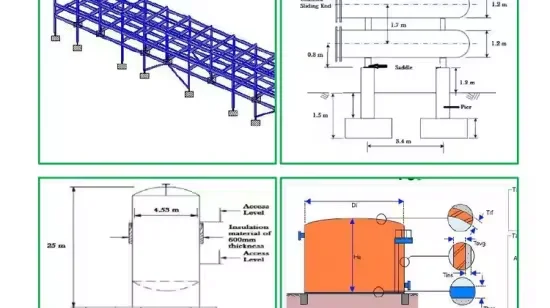
This course is a broad overview of one field of civil engineering, namely onshore structural design. The different structures involved in a plant facility is discussed along with the design of the supports. The basic structures include: horizontal vessels, vertical vessels, above ground steel storage tanks and pipe racks. A birds eye view of different plant facility types is simplified. This has been made possible as plants, petrochemical and industrial facilities comprise of similar structures, although for different purposes. Thus for someone new to this field of civil engineering, this course takes one to a professional level.
The course starts off with an elevated view of plant, petrochemical and industrial facilities. With this view, a summary of the similarity between the different facilities is described. Afterwards, considerations for the layout design of a plant facility is covered. Then focus shifts to atmosphere for explosion, ATEX zones.
Next up is the design of supports for horizontal vessels. For this course, horizontal vessels are subdivided into 2 types. Heat exchangers and horizontal vessels. The different load cases and the side of the horizontal support to be designed is highlighted. Afterwards, vertical vessels are designed for. For vertical vessels, the two important supporting components are the pedestal and the footing segments. The criteria for selection of either a square or an octagonal pedestal/footing is described.
Afterwards, the design of above steel storage tank is done. Unlike the horizontal and vertical vessels which are supplied by a manufacturer, the above ground storage tank is in whole designed by a structural engineer.
The course closes with a look at pipe rack configuration design and load estimation. The pipe rack is basically a frame structure. How to generate the distance between the frames is covered in the course. As well as selection of structural members and estimation of load. An overview of piping & pipeline design is included. This section aids with understanding how to select the right pipe materials for a given environment and fluid properties and purpose. From this pipe selection, the load per meter length of a pipe can be known for used in structural design calculations. In addition, corrosion prevention and control overview is covered in order to offer a holistic understanding of material design.
Included in the course are downloadable manual calculation sheets. These calculation sheets are to be studied and then the steps replicated for the calculation assignment. References to code have been done in a stepwise manner to aid understanding of manual calculations and the relevant codes of practice.
In order to validate the manual calculations, for personal confidence, installation of STAAD Foundation software is necessary. Calculation sheets for this software have also been included and is a way to validate the manual calculations from the book. The input into STAAD Foundation are also downloadable.
Who this course is for
This course is most ideal for civil engineers who are still undergraduates and also for those with a low number of years of experience.
Homepage
https://www.udemy.com/course/onshore-structural-design-step-by-step-calculations
Shipping & Delivery
DIGITAL DELIVERY ONLY
This is digital product THE DOWNLOAD LINK SEND 12-24 HOURS AFTER UPON PURSUASE AND PAYMENT CLEARS"
- The digital files are uploaded on PCLOUD
- 12-24 hours delivery time
- the download links expire after 7 days and need to download them
- to renew the download link after expiration have one additional fee $5 per product
REQUESTS
Also we accept requests and course exchanges
In Course exchanges we are sending credits only
The credits will be the same price as we can sell course
"REFUNDS & RETURNS"
No Refunds on digital product
ONLY EXCHANGE
- Because of the abuse of the refunds from many customers i don't accept refunds
- We accept only 1 time exchange with product of the same price
- if you done mistake on the exchangeable product i don't recognize it as your mistake
- Exchanges only 3 days after the payment of your digital product. (if abused again i will do it 1 day)


